
Bangladesh's Home Minister Salahuddin Ahmed will skip the first-ever BIMSTEC home ministers' meeting in New Delhi, with a senior bureaucrat leading the delegation. This absence underscores strained India-Bangladesh ties, particularly following the ouster of the Sheikh Hasina government in August 2024 and Dhaka's request for her extradition from India.

Under the shadow of the serial blasts in India, foreign ministers of the eight-member South Asian association for Regional Cooperation met on Thursday in Colombo to set the agenda for the weekend summit aimed at boosting trade ties and combating the food and energy crisis.

Pakistan will not engage with India 'until and unless they lift the siege' in Kashmir, it said.
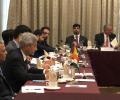
Jaishankar was among the first ministers to arrive for the SAARC ministerial meeting. He was in the meeting for over 45 minutes and then left.

India's envoy to Austria, Sheel Kant Sharma, will be next secretary general of South Asian Association for Regional Cooperation, External Affairs Minister Pranab Mukherjee announced on Friday.
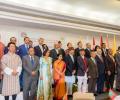
Connectivity is what SAARC needs the most but Pakistan is not interested, says Rajeev Sharma.

It is expected that this meeting could possibly pave the way for a meeting between Prime Minister Narendra Modi and his Pakistani counterpart Nawaz Sharif in the US later this month.
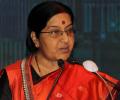
India on Thursday pitched for unleashing the "collective strength" of the South Asian Association for Regional Cooperation as External Affairs Minister Sushma Swaraj underlined the need for a South Asian Economic Union with greater connectivity and forward movement on pending agreements on rail and motor vehicles.

In his opening address, Prime Minister Modi said the South Asian region has reported less than 150 coronavirus cases, but "we need to remain vigilant". "Prepare, but don't panic" has been India's guiding mantra in dealing with coronavirus outbreak, he said.

On the eve of their crucial talks, External Affairs Minister S M Krishna had a friendly chat with his Pakistani counterpart Shah Mahmood Qureshi on the sidelines of an informal working dinner of SAARC Foreign Ministers in New York

According to top official sources, the foreign secretaries will meet only after the Special Investigation Team from Pakistan arrives in India and makes concrete progress in the probe.
Pakistan on Friday said it is going to the upcoming foreign-secretary level parleys with India with an 'open mind' and was hopeful of a 'constructive attitude' from it so that the stalled peace process can be resumed. Referring to the upcoming meeting between the foreign secretaries of Pakistan and India on the margins of the SAARC Council of Ministers meeting in Bhutan, Foreign Office spokesman Abdul Basit said, "Pakistan is going to Thimphu with an open mind".

Raising the Kashmir issue at the SAARC meeting, Pakistan's Interior Minister Chaudhry Nisar Ali Khan on Thursday alleged that the violence being committed in Kashmir is "open terrorism".
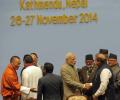
In a phased and planned manner the countries will go for Free Trade Areas, a Customs Union, a Common Market, and a Common Economic and Monetary Union.
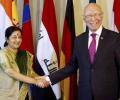
Quoting diplomatic sources, The Express Tribune reported that India and Pakistan were exploring the possibility of a meeting between Swaraj and Aziz and also between the foreign secretaries of the two countries in the Nepalese tourist city of Pokhara.
India on Wednesday asked its South Asian neighbours to increase intra-regional trade as a cushion against slowdown in exports to the US and European markets.

Modi is likely to hold separate bilateral meetings with the foreign leaders.

There is a view that heavyweight portfolios like home, finance, defence and external affairs besides education and culture, two ministries with strong ideological hues, will be kept by the BJP, while its allies can get anywhere between five to eight cabinet berths.

According to Bambawale, even while tensions were high between the two nations, there had been contacts at the operational level.
'The performance of any government is benchmarked on five parameters -- India's external security, the state of the economy, social cohesion, internal security, and India's relations with the world or its foreign policy. On each of the benchmarks in the past nine years, the NDA-BJP government has come up completely short'

Former external affairs minister, K Natwar Singh, shares his critique of the Narendra Modi government's foreign policy in this e-mailed interview with Aditi Phadnis. Edited excerpts

'Pakistan's negativism should be seen as the reason for India losing interest in SAARC.'
'There is nothing that Pakistan has done which deserves a resumption of dialogue. The assurances made in Ufa contain no commitment except a whole range of talks, which could take place without the paraphernalia associated with a joint statement of prime ministers.'

10 takeaways from the prime minister's UN speech.

'One cannot escape the conclusion that Pakistan has won the Paris-Bangkok-Islamabad round. To be able to resume the composite dialogue without making any progress on the Mumbai attack trials is a dream come true for Pakistan.'

Northeast India's diverse and colourful culture were in full display as the curtains were brought down on the 12th South Asian Games amid magnificent fireworks that lit the night sky over Guwahati.

India's soft power diplomacy came into play during this cataclysm affecting the world as the pandemic defies barriers and borders, notes Rup Narayan Das.

India wants good relations with Pakistan but the neighbouring country must stop terror activities directed against it as talks will get subdued under the din of bomb blasts, Sushma Swaraj said after taking charge as External Affairs Minister on Wednesday.
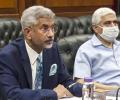
'Terrorism continues to be the overwhelming threat to security and stability in the SCO region and therefore Dr Jaishankar strongly pitched for 'collective action',' observes Dr Rajaram Panda.

Here are the top 10 quotes from the speech to a gathering of around 50,000 Indians at the Dubai International Cricket stadium
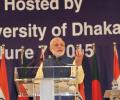
In a blunt attack on Pakistan, Prime Minister Narendra Modi on Sunday accused it of creating "nuisance" and "constantly" troubling India by promoting terrorism.

Referring to the COVID-19 pandemic, Modi said India has always prided itself as the first responder in the region - a friend in need.

'From the very start, PM Modi was insistent that visiting foreign leaders should be exposed to an India beyond its capital.' 'Through these experiences, he felt that the full Indian narrative would be much better understood across the world,' explains External Affairs Minister S Jaishankar. A riveting excerpt from Bluekraft Digital Foundation's Modi@20: Dreams Meet Delivery.

The leaders discussed other topical issues before the United Nations during the ongoing 69th Session of the General Assembly.
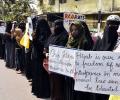
India and Indians can ignore Pakistan, but that cannot be said of other nations in the neighbourhood, where New Delhi's 'Neighbourhood First' policy constantly reverberates. Four of the eight SAARC member-nations are Muslim -- Afghanistan and Pakistan, Bangladesh and the Maldives. The rulers decide the nation's India or anti-India policy in the first two, and street-opinion contributes to the same in the latter two, points out N Sathiya Moorthy.

Pakistan's prime minister is trying to use the unrest in Kashmir to save his government, says Ambassador G Parthasarathy, a former high commissioner to Islamabad.

Pakistan on Thursday asked the world community to play its role in the peaceful resolution of the Kashmir issue, saying it wants to resolve it in a peaceful manner and through result-oriented and sustained dialogue.
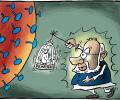
Has Modi -- after announcing the life-crushing demonetisation, the abrogation of Article 370 and the CAA/NPR/NRC without any consultation -- suddenly realised the value of taking everyone on board, asks Krishna Prasad.

The earliest ones included whistles shaped like birds, toy monkeys that could slide down a string and small carts made from materials found in nature such as sticks, clay and rocks. While there might be no disputing India's rich toy-making tradition, the industry is languishing for lack of investment and technology, and also owing to competition from cheap imports. And though it has been listed among 24 key sectors under the government's Atmanirbhar Bharat Abhiyaan, the question remains: will this push help place it in the global game? Currently, 80-odd per cent of the toys sold in India are imported - nearly 60 per cent of them from China.
